Thursday, November 15, 2007

Fitness - study of life

fitness is a central concept in evolutionary theory. It describes the capability of an individual of certain genotype to reproduce, and usually is equal to the proportion of the individual's genes in all the genes of the next generation. If differences in individual genotypes affect fitness, then the frequencies of the genotypes will change over generations; the genotypes with higher fitness become more common. This process is called natural selection.
As fitness measures the quantity of the copies of the genes of an individual in the next generation, it doesn't really matter how the genes arrive in the next generation. That is, for an individual it is equally "beneficial" to reproduce itself, or to help relatives with similar genes to reproduce, as long as similar amount of copies of individual's genes get passed on to the next generation. Selection which promotes this kind of helper behaviour is called kin selection.
Fitness is another wau to keep our lifes good as usual.

Saturday, November 3, 2007

How to switch to a Macrobiotic diet

A person considering adopting the Macrobiotic diet system, should spend some time researching the philosophy as well as the specific foods and cooking techniques used.
How anyone can choose to transition into a full macrobiotic way of eating and being?
The best way to transition to a macrobiotic diet, is to first employ a wholefoods diet for several months before going into the more restrictive macrobiotic way of eating and being. A wholefoods diet requires erradicating all heavily processed and refined foods such as granulated sugar, refined flour, and most canned or pre-prepared foods. The next step is that one would begin erradicating all dairy products and red meat, while utilizing only whole grains. Finally, particularly during these transition periods, it is important to be very aware of what is going on in your body and your body's response to the foods you intake.
Also, it is recommended that one researches the diet and either consults a macrobiotic counselor or makes a gradual transition to the macrobiotic way of eating. A well-trained macrobiotic counselor will orient the person not only toward the correct foods and methods of eating, but will also guide the person to a more aware state of being.

Thursday, October 18, 2007

Pilates - exercise equipment

Around 1914, Joseph Pilates was a performer and a boxer living in England and, at the outbreak of WWI, was placed under forced internment along with other German nationals in Lancaster, England. There he taught fellow camp members the concepts and exercises developed over 20 years of self-study and apprenticeship in yoga, Zen, and ancient Greek and Roman physical regimens. It was at this time that he began devising the system of original exercises known today as "matwork", or exercises done on the floor. He called this regimen "Contrology." A few years later, he was transferred to another camp, where he became a nurse to the many internees struck with wartime disease and physical injury. Here, he began devising equipment to rehabilitate his "patients," taking springs from the beds and rigging them to create spring resistance and "movement" for the bedridden.

In a way, Pilates equipment today is not much different than that of yesteryear. Spring tension, straps to hold feet or hands, supports for back, neck and shoulder are as important now as they were then. Because of the remarkable nature of the equipment to both challenge and support the body as it learns to move more efficiently, the inimitably designed pieces truly act as a complement to the challenging "matwork" exercises. The Pilates exercise are not hard to complete.

Saturday, October 13, 2007

Philosophy - Macrobiotic diet

Followers of the macrobiotic approach believe that food and food quality powerfully affects health, well being, and happiness. The macrobiotic approach suggests choosing food that is less processed and more natural, and employing more traditional methods of cooking for family, friends, and oneself. One goal of the macrobiotic philosophy and practice is to become sensitive to the true effects of foods on health and well being. In this way, one goes beyond rules and regulations concerning diet to choosing foods that sustains one's health. In this way, dietary guidelines help one to develop sensitivity and an intuitive sense for what sustains one's health and well-being in diet as well as relationships and activities.


Macrobiotics emphasizes locally grown whole grain cereals, pulses (legumes), vegetables, seaweed, fermented soy products and fruit, combined into meals according to the principle of balance. Dietary recommendations include whole grains, such as brown rice, and other whole grain products, such as buckwheat pasta; A variety of cooked and raw vegetables; beans and bean products, such as tofu, tempeh and miso; sea vegetables; mild natural seasonings; fish; nuts and seeds; mild (non-stimulating) beverages, such as bancha twig tea; and fruit.
Certain types of vegetable-fruits, such as tomatoes, peppers and eggplant, are not recommended and are either avoided altogether or used very sparingly.

Wednesday, October 10, 2007

Macrobiotic diet

Macrobiotics ( the translation is long life ) is a dietary regimen that involves eating grains as a staple food supplemented with other local foodstuffs such as vegetables and beans. Although in macrobiotics people may opt to use Japanese ingredients (Japan being the cradle of contemporary Macrobiotics), according to the general guidelines people should use the ingredients that are found locally, and avoid the use of sugar and other highly processed or refined foods. Macrobiotics also addresses the manner of eating by recommending against overeating and requiring that food be chewed thoroughly before swallowing.

The composition of Macrobiotic diets:
Macrobiotics is an approach to life rather than a diet. General Guidelines for the diet are:
Whole grains, especially brown rice: 30-50%
Vegetables: 25-50%
Beans and Bean Products: 10-20 %
Miso soup: daily
Seaweed: small amounts daily
The remainder is composed of fish and seafood, seeds and nuts, seed and nut butters, seasonings, sweeteners, fruits, and beverages. Other naturally raised animal products may be included if needed during dietary transition or according to individual needs.

Tuesday, October 2, 2007

Fitness competition

Fitness competition is a class of physique events for women bearing a close resemblance to female bodybuilding, but with significantly less emphasis on muscle size. These competitions are frequently held as part of the same event as bodybuilding contests.
Fitness and figure are two distinct forms of competition. However, the physique guidelines are similar, and many women cross over from one to the other.
Fitness competition consists of a swimsuit round and a routine round. In the swimsuit round, the competitors wear two-piece swimsuits with high heels, and present their physiques with a series of quarter or half turns. Physique guidelines for fitness typically indicate a preference for a small amount of muscularity with separation, but no visible striations or excessive leanness.
The swimsuit must cover at least fifty percent of the glutes; no thongs or G-strings are allowed. The routine round requires a performance including aerobics, dance, or gymnastics.
The two most prestigious professional fitness contests are the Fitness Olympia and the Fitness International. Fitness competition is a very good way to practice. It's more interesting and fun.


Monday, October 1, 2007

The Muscle

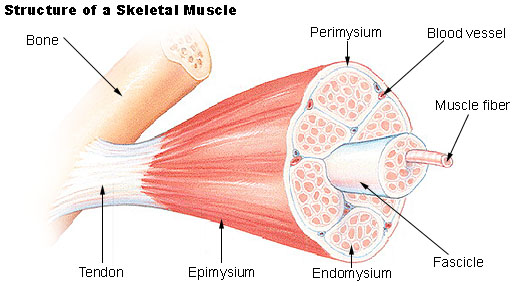
The muscle is contractile tissue of the body and is derived from the mesodermal layer of embryonic germ cells. It is classified as skeletal, cardiac, or smooth muscle, and its function is to produce force and cause motion, either locomotion or movement within internal organs.Much of muscle contraction occurs without conscious thought and is necessary for survival, like the contraction of the heart, or peristalsis (which pushes food through the digestive system).
Voluntary muscle contraction is used to move the body, and can be finely controlled, like movements of the eye, or gross movements like the quadriceps muscle of the thigh.

There are two broad types of voluntary muscle fibers, slow twitch and fast twitch. Slow twitch fibers contract for long periods of time but with little force while fast twitch fibers contract quickly and powerfully but fatigue very rapidly. The muscles are one of the most needed part of the body.